Alopecia areata, treatment, causes, cure, and types
The alopecia areata is a disease of the hair follicles that causes hair loss in men, women, and children. Its origin is unknown, although numerous studies indicate causes that favor its appearance. In this article, we will delve into what it is, the causes that provoke it, the types that exist, and the various current treatments applied by dermatologists.
Contents
What is alopecia areata
Alopecia areata is a hair ailment, inflammatory and chronic, that affects the hair follicle. It causes hair loss on the head and body. As such, there are different types of alopecia areata located in the various parts where hair grows.
As a chronic hair condition, over time, the person who suffers from it may experience different episodes of hair loss. If the first episode is diagnosed, symptoms may reappear at another time, even after years.
* 20% are over 40 years old.
* 12% will notice symptoms after the age of 50.
Types of alopecia areata
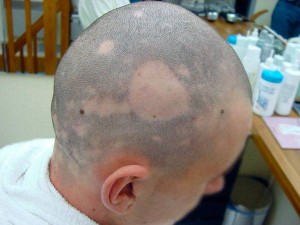
As we have mentioned, this type of ailment does not only affect the scalp. Alopecia areata or AA can affect all areas where hair follicles exist, which is the place of hair growth. Thus, cases of AA in beard, eyebrows, eyelashes, pubis, and intimate areas can be found. Any place on the human body where hair or fur exists can be affected by the disease.
According to the pattern of hair loss, different clinical variants are classified:
Single or unifocal plaque: shows a single alopecic plaque in an oval or round shape. In the surrounding area, there are hairs with a normal and healthy appearance, that is, the edge of the plaque ends abruptly.
Multiple or multifocal plaques: the symptoms are identical to the unifocal except that more than one affected area appears. It can occur both on the scalp and on body areas.
Ophiasis: hair loss is shown in the entire temporal and occipital area, becoming a large surface that reaches the entire scalp.
The most common or so-called classic types are:
Areata totalis (AT): there is a total loss of hair.
Alopecia areata universalis (AU): total hair loss on the body. It affects all areas where hair follicles exist without exception: eyelashes, eyebrows, pubis, armpits, beard, legs, chest, arms, etc.
Types of atypical areata:
These are the clinical cases categorized according to the pattern of hair loss.
Sisaipho (inverse ophiasis): it is the opposite of ophiasis. Hair loss occurs in the lower margins, that is, in the birthline that borders the entire scalp.
Reticular: it is multiple. The symptoms are the appearance of several alopecic plaques separated by small lines of healthy hair. The visual aspect is that of hairless bites.
Diffuse alopecia areata: the pattern is diffuse and not localized. It is generally detected in children and adolescents. In adults, it is usually found as an initial phase of universal or total alopecia.
Acute diffuse: a diffuse pattern that advances very quickly to the entirety. It was first described by Dr. Sato-Kawamura.
AA enroached: intact locks remain within the alopecic plaques.
AA Maga/FAGA: takes a pattern similar to male and/or female androgenic alopecia. Often it is difficult to differentiate them at first.
AA perinevoid: hair loss occurs around a melanocytic nevus. These are spots or freckles with a dark tone that everyone has on their skin. In the case of perinevoid AA, hair loss occurs surrounding the nevus.
AA Marie Antoinette or Thomas More: so called depending on whether the patient is a man or a woman. The symptoms are the loss of pigmented hair, with color, while white hair remains intact and without signs of falling out.
Differences with other alopecias
Alopecia areata is not a scarring alopecia, and thanks to the fact that the hair follicle is not damaged, it does not scar, making hair recovery possible.
Making a diagnosis that differentiates it from androgenic alopecia is difficult. Cases of diffuse alopecia areata show very similar symptoms to telogen effluvium, making the distinction somewhat tricky, especially in the initial phases of both. For this, it is often necessary to perform serology, trichogram, and/or scalp biopsy that will define the state of the scalp cells.
Causes of alopecia areata
As we mentioned, it has unknown causes although there are many studies that agree in pointing out as the most probable cause a imbalance of the organism or an aggression to the scalp.
The etiology indicates the causes of alopecia areata:
- Genetic factors
- Immunological reactions
- Psychosomatic/psychiatric disorders
- Stress
- Associations
- Nevus
- Paraneoplastic: Hodgkin’s disease
Symptoms of alopecia areata
In general, people seeking treatment for alopecia areata show symptoms of hair loss in patches or localized areas, although this is not always the case. Detecting it early is crucial. Initially, hair falls out in very localized areas except in diffuse cases. Small portions the size of a coin are left devoid of hair or hair that covers them.
The visual aspect of alopecia areata is white and smooth to the touch when rubbed with the fingertip over the surface of the patch. Because the follicle is diseased, some people exhibit subcutaneous swelling. Occasionally, upon close inspection, hair follicles may appear dilated and even resemble a perforated surface. Some patients can pull hair from the edges of the patches with a gentle tug. This occurs due to the weakness of the follicle, which lacks the strength to hold the hair root.
Alopecia areata, treatment and cure

To provide an effective treatment, it is first necessary to diagnose it efficiently. People who visit the dermatologist with hair loss problems must undergo a classification of their loss pattern (patches, ophiasis, diffuse), body area, family history, age of the subject, speed of loss, and the duration of the disease. Depending on these factors, the prognosis will be more or less favorable. In any case, before starting a treatment for alopecia areata, the side effects of the medication must be evaluated. Once a method to cure is implemented, it should be followed for several months, evaluating and monitoring to verify if the results are indeed positive. The dermatologist will certify if the treatment is having the expected effects to continue with the medication or switch to an alternative method.
Generally, therapies are progressive, that is, treatments are used from less to more. First, the milder ones, with fewer side effects for the body, and as it is detected that they do not work, progress to more aggressive products.
Although alopecia areata does not have a direct impact on the human psyche, its effects, in many cases, end up affecting the subject who suffers from it. In these cases, the dermatologist, initially, should assess the patient to calm them and refer them to a psychotherapist if symptoms are noticed. It is evident that there are cases with a psychological origin, and others are aggravated by the stress caused by suffering from any of the clinical alopecias. In any case, the psychological discomfort of the patient is a factor that can accelerate the hair loss process.
Classification of treatments according to their administration
We can group the different treatments for alopecia areata by the way they are applied and/or their functionality.
- Antraline
- Corticosteroids
- Ciclosporin
- Minoxidil
- Immunotherapy
- Phototherapy and photochemotherapy
- Prostaglandin analog
- Tacrolimus
- Imiquimod
- Intralesional candidin
- Topical rubefacients
- Laser
- Corticosteroids
- Ciclosporin
- Methotrexate
- Sulfasalazine
- Immunomodulators
- Biological therapies
The systemic treatments differ from the topical ones in that they act from within the human body. They can be taken orally or by injection and are often used for patients with severe symptoms. Following the example of treatments from less to more, in the initial stages of AA, topical products would first be used, and if they do not work, systemic ones could be used.
In all cases, the treatment to cure alopecia areata is evaluated based on the diagnosis, symptoms, and particular characteristics of each individual.
Prognosis
It should be noted that there are treatments that cure alopecia areata in a high percentage of cases, although the prognosis is always complicated. This is a disease that severely affects the quality of life of many people.
In all cases, it is necessary to diagnose the causes and act based on them, thus following a treatment focused on eliminating the origin and mitigating the symptoms. AA due to genetic causes is not the same as one caused by stress. However, more than 50% of patients with areata experience prompt and spontaneous recovery without treatment. Most of them, around 85-90 percent, recover hair in the patches, or the patches are reduced.
However, alopecia areata is a chronic disease, and throughout the subject’s life, episodes of hair loss may recur.
In cases where it is not possible to eradicate the disease to its minimum expression, and therefore it is not possible to stop hair loss, the affected regions end up merging. This causes several small alopecic patches to become a single large hairless area. It is common to find patients with chronic symptoms with the fusion of patches and, in some cases, total hair loss.
In cases of body areata, the effects are often reversible.
References:
Sato-Kawamura in 2002.
Díaz Leaño Janis, Study of clinical epidemiological characteristics in the adult population. Year 2012.
Dr. Antonio J. Rondón Lugo, Clinical pathological aspects of AA. Spain