Diffuse alopecia: Do you doubt the treatment? What about the diagnosis?
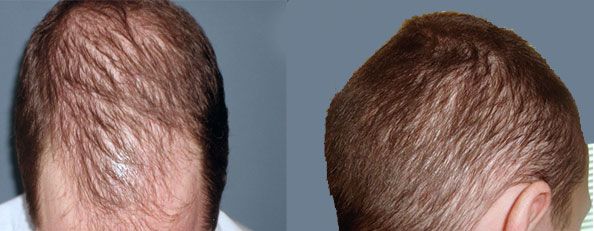
Peter tells us that he is 19 years old and has noticed hair loss for the past 3 years due to diffuse alopecia. As the months go by, he sees the shedding increase and feels that in no time he will be completely bald.
After all this time, he says, I went to the dermatologist encouraged by a friend of mine. The first thing he asked was if I had any patients with androgenetic alopecia. What!? What!?
Contents
Honestly, after reading a lot of articles online, I was very puzzled. First, because the hair loss pattern I have is not at the frontal line. My hair is not falling out at the temples. My problem is that I have less hair all over my head every day, not just at the temples. The top of my head is getting completely exposed! Evidently, the temples are where it shows the most, but I think this is common to all who suffer from alopecia.
The treatment for diffuse alopecia that I am currently taking is Propecia. Is this effective? Do I need to take something else? Should I trust the dermatologist?
This is a typical case of someone who visits a dermatologist with symptoms of hair loss. Their reaction is quite common when interpreting the symptoms by the doctor.
 Our recommendation is that when there are doubts about the accuracy or professionalism of a dermatologist, it is best to get a second opinion. For serious problems, and diffuse alopecia is serious for those who suffer from it, especially if you are a young guy like Peter, the most sensible thing is to see a second dermatologist for their diagnosis.
What do you achieve with a second diagnosis of diffuse alopecia?
- Relaxation: once two specialists tell us we have the same condition, our mind relaxes. We accept the diagnosis and start fighting the disease. This happens both in cases of alopecia and other serious illnesses.
- Acceptance: if, as is normal, the second dermatologist makes the same diagnosis, it is logical that we get the same treatment. There may be some difference in the initial doses, but as a general rule, they should coincide. The initial differences dissolve as the treatment for diffuse alopecia progresses and doses are adjusted according to the patient’s evolution.
- Discrepancy: this is the downside of having two opinions. If they are conflicting, it initially nullifies all the advantages until we are sure of what is really happening to our hair and why it is falling out.
Disadvantages of a second diagnosis
- Getting two different diagnoses of what is happening to us. Each report says one thing, and we don’t know what to do.
- Double the doubts, creating anxiety and potentially leading to depressive states.
- Choosing between one of the two diagnoses or consulting a third specialist for their opinion.
- Your hair keeps falling out while you spend time figuring out what the real problem is.
- If you do not go through social security, an alopecia diagnosis costs money, although you can always request a change of dermatologist in social security.
As you can see, a second diagnosis of what is happening to our hair can cloud the situation more than clarify it, but the positive side is that it uncovers a possible error and, although initially causing disorientation and discomfort, in the long run, it is advantageous. And we explain why.
Advantages of a second diagnosis
- You will get an accurate method to stop hair loss.
- Mentally committing to the treatment. There are numerous clinical studies indicating that the patient’s conviction results in better outcomes.
- You don’t lose time. When hair loss is rapid, a year with inadequate products is hard to recover.
- Mental tranquility. The best part is that you will stop thinking that you are not doing everything necessary to stop diffuse alopecia. Believing you are acting with all the means at your disposal significantly reduces the anxiety caused by suffering from it.
What to do when there are two different diagnoses
These situations are always complicated because confusion and frustration are added to the discomfort. The person suffering from diffuse alopecia facing two diagnoses doesn’t know what to do, sometimes thinking of giving up and letting it progress on its own, and other times indignation and anger grow, leading to depression. The best thing in these cases is to try, which is not easy, to take it calmly and think carefully about why there are inconsistencies between dermatologists. Experienced professionals rarely make mistakes, so we should not distrust them lightly.
Think it over and meditate on this
You may come to other conclusions, but perhaps these points will help you when thinking about why two dermatologists are convinced that they are different conditions when the case is the same.
- If two specialists differ in their diagnosis, it may mean we have symptoms that overlap and resemble different types of alopecia. This causes what seems diffuse to one dermatologist to appear androgenetic to another specialist.
- Although it seems evident, in many cases the symptoms are only distinguishable over time.
- Treatments are sometimes a matter of trial and error. Unfortunately, some people have to try different doses or products until they find one that works for their problem.
- We must decide which diagnosis to follow or, if unsure, seek a third opinion.
Recap and conclusion
The case presented here, and the doubts it raises, although rare, do occur sometimes. We did not want to create distrust regarding the professionals who care for our scalp health and consequently the vitality of our hair every day but to clarify why it is sometimes so difficult to get it right the first time. In any case, as we have mentioned several times, there are occasions when the best diagnosis is to see the evolution over time and, based on that, adjust the treatment for diffuse alopecia.